
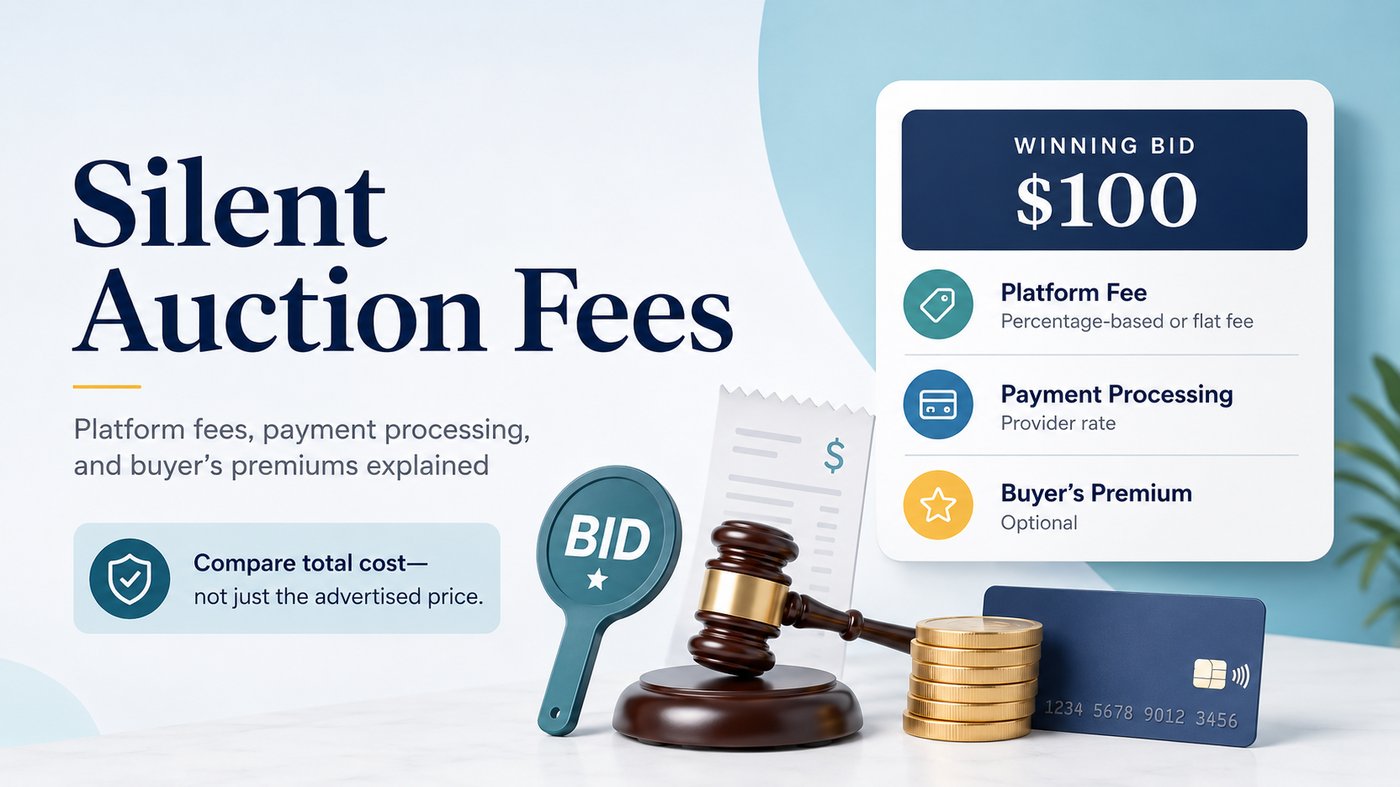
Online silent auction costs generally fall into three categories: auction software or platform fees, payment-processing fees, and optional charges passed to bidders. Some platforms charge a subscription or setup fee, while others charge a percentage only when an item sells. Always calculate the total cost using your expected auction revenue rather than comparing advertised prices alone.
With BiddingOwl, the platform fee is 5% of winning online bids. Payment processing is handled separately through the organization’s chosen provider, such as Stripe, PayPal, or another available payment provider. Organizations may absorb these expenses or offset them by adding a clearly disclosed service fee or buyer’s premium.
| Type of fee | What it covers | Common pricing method | Who charges it? |
|---|---|---|---|
| Auction platform fee | Auction software, bidding tools, and event administration | Subscription, setup fee, flat event fee, or percentage | Auction software provider |
| Payment-processing fee | Processing electronic payments | Percentage of the payment, sometimes plus a fixed transaction charge | Stripe, PayPal, or another payment provider |
| Service fee or buyer’s premium | An optional amount added to the bidder’s purchase | Usually a percentage of the winning bid | Set by the organization |
| Event expenses | Venue, food, equipment, printing, and staffing | Varies by event | Event vendors and service providers |
The total cost of a silent auction is not necessarily the price advertised by the auction platform. Organizations should include software, payment processing, optional features, event expenses, and staff time when comparing their options.
The main costs of an online silent auction are the platform fee and the payment-processing fee. An organization may also have event expenses or add an optional buyer’s premium to winning purchases.
The exact combination depends on the auction platform, payment provider, event format, and decisions made by the organization.
An auction platform fee is the amount charged for using the software that manages auction items, bidders, bids, invoices, payments, and event activity.
A platform may charge:
Organizations should not assume that every percentage-based platform uses the same calculation. One platform might apply its percentage only to winning auction bids, while another might apply it to donations, ticket sales, sponsorships, or total event revenue.
A payment-processing fee is charged by the company that processes the bidder’s electronic payment.
The processing provider may be Stripe, PayPal, or another payment service. Processing fees are generally determined by the organization’s agreement with that provider, not by the auction platform.
The payment-processing fee may include:
Organizations should review their provider’s current terms and use the actual rate when estimating auction proceeds.
A service fee or buyer’s premium is an optional amount added to the winning bidder’s purchase.
The organization selects the amount and explains it to bidders. The additional charge can be designed to offset some or all of the auction platform and payment-processing costs.
For example:
| Checkout item | Amount |
| Winning bid | $100 |
| 9% buyer’s premium | $9 |
| Bidder’s total before other applicable charges | $109 |
The winning bid remains $100. The additional $9 is added to the bidder’s checkout total.
Auction platforms commonly use subscriptions, flat event fees, percentage-based fees, or a combination of charges.
Understanding the pricing model is important because two platforms with similar advertised prices may produce very different total costs.
A subscription gives the organization access to the software for a recurring monthly or annual price.
This model may be economical for organizations that conduct several auctions, but it can be expensive for a nonprofit that holds only one event each year.
Organizations should verify:
A flat event fee is charged for each auction, regardless of how much the auction raises.
This provides predictable software costs. However, it requires the organization to pay the full amount even if the event raises less than expected.
A percentage-based platform fee is connected to auction results or transaction volume.
Before selecting this model, ask what amount is subject to the percentage:
A percentage applied only to winning auction bids is different from a percentage applied to every dollar collected during the fundraiser.
Some platforms combine subscriptions, setup fees, percentage charges, and paid add-ons.
The advertised subscription price may therefore represent only part of the final cost.
Organizations should ask for a complete list of charges before choosing a platform.
BiddingOwl charges a 5% platform fee on winning online bids. Donations, Tickets, Fund-A-Need, paddle raises, or such are NOT subject to the 5%. Those features are free of charge.
The calculation is:
Winning online bid × 5% = BiddingOwl platform fee
Here are several examples:
| Winning online bid | BiddingOwl platform fee |
| $50 | $2.50 |
| $100 | $5 |
| $250 | $12.50 |
| $500 | $25 |
| $1,000 | $50 |
For a $100 winning online bid:
$100 × 5% = $5
The 5% calculation is based on the winning online bid. Payment-processing costs are separate and are determined by the organization’s payment provider.
The organization’s selected payment provider processes bidder payments and transfers the proceeds according to the provider’s terms.
Depending on the options available to the organization, the provider may be Stripe, PayPal, or another payment processor.
The payment provider—not BiddingOwl—determines the applicable processing fee. This means two organizations using the same auction platform could have different payment-processing costs.
Organizations should check:
No. The BiddingOwl platform fee and the payment-processing fee are separate costs.
BiddingOwl’s fee is 5% of winning online bids. The payment-processing charge is determined by the organization’s selected provider and is generally deducted as part of processing the bidder’s payment.
Keeping the two charges separate makes it easier to understand the cost of the auction software and the cost of accepting electronic payments.
Net auction proceeds are calculated by subtracting platform costs, payment-processing costs, and other event expenses from the total amount collected.
A general formula is:
Amount collected − platform fees − payment-processing fees − other auction expenses = net proceeds
For BiddingOwl, the platform-fee portion is:
Winning online bids × 5% = BiddingOwl platform fee
The processor’s actual fee must then be calculated using the organization’s payment-provider rate.
The exact cost depends on the auction platform and payment provider.
The following BiddingOwl examples show how a platform fee, processing fee, and buyer’s premium may affect a $100 winning online bid.
Suppose:
The calculation would be:
| Calculation | Amount |
| Winning online bid collected | $100 |
| BiddingOwl platform fee | −$5 |
| Illustrative payment-processing fee | −$3.20 |
| Estimated proceeds | $91.80 |
The payment rate above is an illustration only. The organization should substitute its provider’s current rate.
Suppose the same $100 item has a 9% buyer’s premium.
| Calculation | Amount |
| Winning online bid | $100 |
| 9% buyer’s premium | $9 |
| Total charged to bidder | $109 |
Using the same hypothetical processing rate:
| Calculation | Amount |
| Total collected | $109 |
| BiddingOwl platform fee on the winning bid | −$5 |
| Illustrative processing fee on $109 | −$3.46 |
| Estimated proceeds | $100.54 |
In this illustration, the buyer’s premium offsets the platform and processing expenses.
The exact premium required to recover all costs depends on the payment-provider rate, fixed transaction charge, average winning bid, and amount processed.
Yes. An organization may set a buyer’s premium or service fee at a level designed to offset the platform fee, payment-processing fee, or both.
Because payment-processing costs may include both a percentage and a fixed transaction charge, one premium percentage will not produce exactly the same result for every purchase.
For example, a fixed $0.30 transaction charge has a greater relative effect on a $25 purchase than on a $500 purchase.
Before selecting a premium, calculate it using:
This helps the organization choose a reasonable percentage that works across typical checkout amounts.
A buyer’s premium should be based on the organization’s actual platform and processing costs rather than selected at random.
Use this process:
For example, an organization using a platform with a 5% fee and a processor charging an additional percentage plus a fixed transaction amount may decide that a buyer’s premium in the high single digits best fits its typical invoices.
The organization should run its own calculations before publishing the final percentage.
A buyer’s premium is traditionally an added percentage based on the winning bid. A service fee is a broader term for an additional checkout charge.
In many fundraising auctions, the two terms describe a similar practical result: an additional amount is added to the bidder’s purchase to help the organization offset auction expenses.
For example:
| Charge | Calculation |
| Winning bid | $200 |
| 8% buyer’s premium or service fee | $16 |
| Bidder’s total | $216 |
The organization should select one term and use it consistently.
Switching between “buyer’s premium,” “service fee,” “processing fee,” and “support fee” can make it difficult for bidders to understand what they are being charged.
A nonprofit may absorb all auction costs, pass them to bidders through a disclosed fee, or divide the costs between the organization and its bidders.
Each approach has advantages.
The bidder pays only the winning-bid amount.
This creates a simple checkout experience, but the organization receives less than the amount shown in winning bids after fees are deducted.
The organization adds a buyer’s premium or service fee intended to offset its platform and payment-processing expenses.
This can preserve more of the winning-bid revenue, but the additional charge must be clearly explained.
The organization adds a smaller service fee that offsets part of its expenses while absorbing the remainder.
This can balance a lower bidder charge with improved net proceeds for the nonprofit.
A buyer’s premium should be disclosed before bidding begins and shown clearly during checkout.
The explanation should state:
A simple disclosure could say:
A service fee will be added to winning auction purchases. This fee helps offset auction-platform and payment-processing costs so that more of the amount raised can support our mission.
Another option is:
A buyer’s premium will be added to each winning bid. The premium helps cover the technology and payment costs associated with conducting the auction.
Place the disclosure in multiple locations, including:
Bidders should not discover the additional charge for the first time after the auction has closed.
Compare silent auction platforms using a realistic estimate of your organization’s expected revenue, transaction volume, and event needs.
Ask each provider the same questions:
Then calculate the total cost using the same sample auction for every provider.
Suppose an auction expects $10,000 in winning online bids.
Under a 5% platform-fee model:
$10,000 × 5% = $500 platform fee
Payment-processing fees would be calculated separately using the organization’s payment-provider rates.
The organization could then compare:
This creates a much more accurate comparison than looking only at advertised starting prices. Follow this guide to compare how auction platforms charge.
Silent auction platforms may charge a subscription, setup fee, flat event price, percentage of revenue, or a combination of charges. The total cost depends on what transactions are included and whether payment processing and optional features are charged separately.
BiddingOwl charges 5% of winning online bids. For example, a $200 winning online bid results in a $10 BiddingOwl platform fee.
The BiddingOwl platform fee is calculated from the winning online bid. Payment-processing costs and any service fee or buyer’s premium are separate parts of the transaction.
Not necessarily. Many auction platforms treat payment processing as a separate cost. With BiddingOwl, processing is handled separately by the organization’s chosen provider.
The payment provider determines its processing rates and account terms. Organizations should review their provider’s current pricing before calculating expected proceeds.
A nonprofit may add a clearly disclosed service fee or buyer’s premium to winning purchases. The amount can be designed to offset some or all of the organization’s platform and payment-processing costs.
Yes. A buyer’s premium is normally added to the winning bid when the bidder checks out. A $100 winning bid with a 10% buyer’s premium produces a $110 checkout total before any other applicable charges.
No. The winning bid remains the amount entered during the auction. The buyer’s premium is an additional charge.
No. A payment-processing fee is charged by the payment provider. A buyer’s premium is selected by the organization and added to the bidder’s purchase. The organization may use the premium to offset its processing and platform costs.
The least expensive option depends on the auction’s size, expected revenue, payment volume, required features, and event format. Compare total projected costs rather than choosing a platform solely because it advertises a low starting price.
Estimate the total amount that will be collected, then subtract the platform fee, payment-processing costs, venue and event expenses, and other applicable charges. Run the calculation using several realistic bidder invoices.
An organization may use a service fee or buyer’s premium designed to offset all of its platform and payment-processing expenses. The exact result depends on the amount charged, the provider’s rate, fixed transaction fees, and the size of bidder invoices.
Payment-processing rates and account terms may change. Organizations should verify current rates directly with their selected payment provider (Stripe, PayPal). BiddingOwl pricing information was last reviewed on August 3, 2026.
The cost of a silent auction depends on how the auction platform charges, how payments are processed, and whether the organization absorbs its expenses or passes them to bidders.
The best comparison begins with a realistic estimate of winning bids and bidder invoices. Calculate the platform fee, add the organization’s actual payment-processing costs, and account for event expenses and optional features.
With BiddingOwl, the platform fee is 5% of winning online bids. Payment processing is handled separately through the organization’s selected provider, and the organization can add a service fee or buyer’s premium designed to offset those costs.
Understanding each part of the calculation allows organizations to choose an auction platform confidently, communicate fees clearly, and protect more of the money raised for their mission.

Nonprofit fundraising strategist sharing proven insights on online auctions, donor engagement, and digital fundraising trends. Helping charities and small nonprofits raise more money through smarter, data-driven fundraising strategies.

Mo-Fri 9 am to 5 pm Eastern Time
24/7 critical emergency support
All currencies supported
