
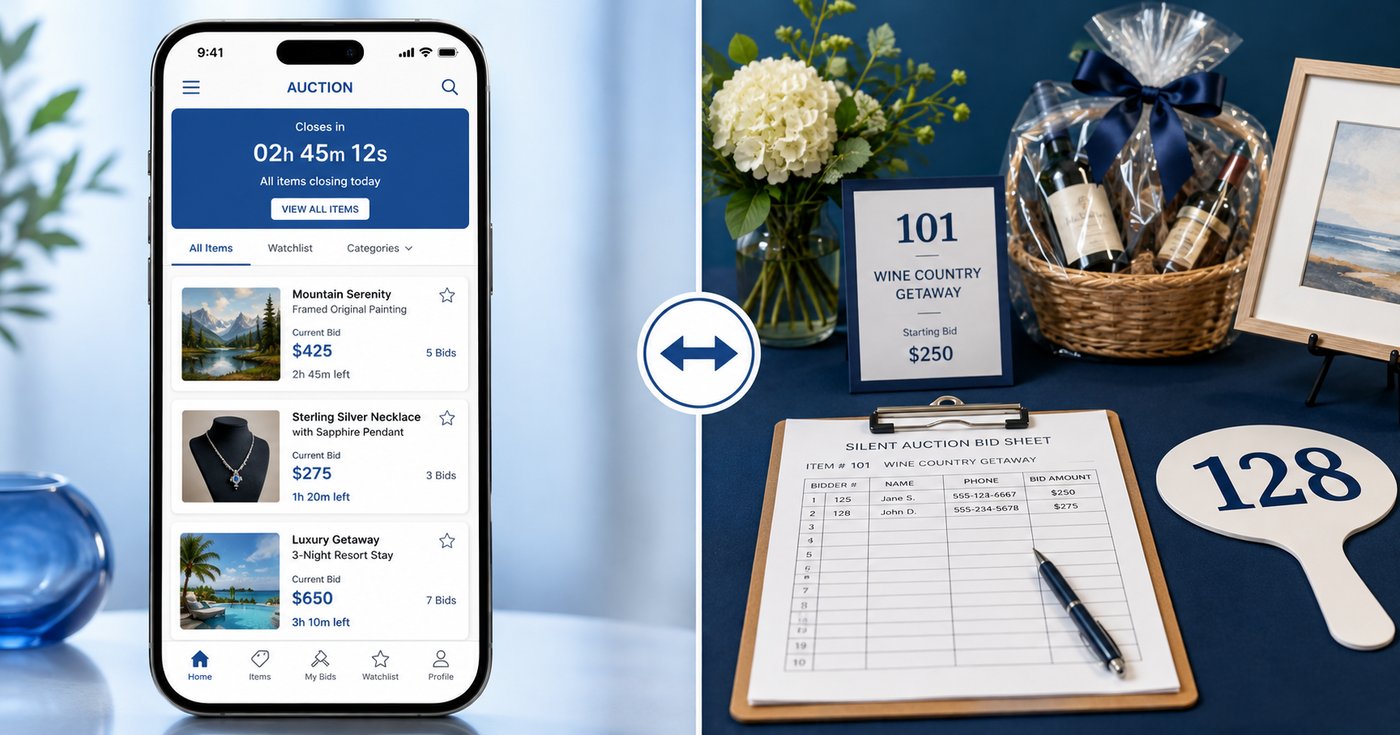
BiddingOwl and BetterWorld both support nonprofit auctions, but they are designed around different priorities. BiddingOwl is the stronger fit when the auction itself is central, and the organization needs online, mobile, paper, live, pre-bid, or hybrid flexibility. BetterWorld may fit organizations that want auctions inside a broader fundraising suite and prefer its donor-supported or paid-plan pricing choices.Disclosure and verification: BiddingOwl publishes this comparison and is one of the products covered. BetterWorld did not pay for inclusion or placement. We reviewed both providers’ official pricing, product, and help pages on August 24, 2026. Features, fees, and terms can change, so confirm current details directly with each provider before making a decision.
| Comparison point | BiddingOwl | BetterWorld |
| Primary focus | Auction-centered fundraising and event workflows | A broader fundraising suite that includes auctions |
| Core pricing approach | No standard monthly or setup fee for core auction use; 5% performance fee on winning online or mobile bids | Free donor-supported plan; Flex plan with transaction fees; Partner and Keystone annual plans with lower transaction percentages |
| Supporter contribution | The organization chooses whether to add a clearly disclosed supporter contribution and selects the amount to help offset its fundraising costs | On Free Forever, BetterWorld presents supporters with a suggested optional contribution to BetterWorld; supporters can change or decline it |
| Traditional silent and live tools | Available without BiddingOwl’s 5% online-bid fee | Live-auction tools are available; confirm the exact event workflow your team needs |
| Online and mobile bidding | Yes | Yes, through a browser with no separate app required |
| Paper bid sheets | Built-in printable bid-sheet tools | Dedicated printable paper bid-sheet functionality was not identified in the official BetterWorld materials reviewed for this comparison |
| Card required before an online bid | Optional. Organizations using Stripe can enable card vaulting. Supporters may browse without a card; when vaulting is enabled, a payment method is required when they place a bid, purchase tickets, or make a donation. | Yes. BetterWorld says an online bidder must place a card on file when submitting a bid |
| Online silent-auction winner payment | With Stripe vaulting, the administrator can charge an applicable saved payment method after the auction. Organizations can also use regular checkout or record cash, check, or another approved offline payment. | BetterWorld’s silent-auction page describes automatic charging of winning cards; the organization can choose not to charge a card and accept another payment method |
| Live-auction winner payment | Organizations can manage live winners, invoices, checkout, and offline payments | The administrator enters the live winning bid; the winner receives an email and completes checkout |
| Cash and checks | Yes. Open the invoice and mark it paid | Yes, when the organization chooses not to charge the bidder’s stored card and collects payment separately |
| Payment processing | The organization connects Stripe or PayPal; processor fees are separate | Card processing applies on all plans; BetterWorld currently publishes 2.9% + $0.30 for credit cards |
| Broader fundraising tools | Donations, tickets, raffles, Fund-a-Need, paddle raises, and related event tools | Donation forms, events, peer-to-peer fundraising, auctions, donor management, integrations, and other campaign tools |
| Published support details | Phone and email support, personal training, Monday–Friday 9 a.m.–5 p.m. Eastern, and 24/7 critical emergency support | Partner includes priority support; Keystone includes concierge support for one event annually. Confirm the support level and response expectations for the selected plan |
| Best fit | Organizations prioritizing auction flexibility, mixed payment methods, paper/live/hybrid workflows, and direct auction support | Organizations seeking a broader fundraising suite and a choice among supporter-funded, transaction-fee, and annual pricing models |
This table summarizes public information rather than a contract or quote. Compare both systems using the exact auction format, payment mix, annual fundraising volume, and support needs your organization expects.
The main difference is focus.
BiddingOwl is centered on charity auctions and the operational choices that come with them. An organization can run a fully online auction, invite mobile bidding at an event, print paper bid sheets, manage a traditional silent or live auction, open online pre-bidding before an in-person event, or combine online and in-person participation in a clearly defined hybrid workflow.
BetterWorld offers auctions as one part of a broader fundraising platform. Its published plans include access to fundraising tools such as auctions, events, donation forms, peer-to-peer campaigns, donor management, integrations, payments, and reporting.
Choose based on the problem you are trying to solve. If the primary challenge is operating an auction across different formats and payment methods, BiddingOwl may be the more natural fit. If the organization wants to consolidate several fundraising activities into one broader platform, BetterWorld deserves consideration.
The two companies use different pricing structures, so a headline percentage does not tell the whole story.
BiddingOwl does not charge a standard monthly subscription or setup fee for core auction use.
A 5% performance fee applies when an item receives a winning online or mobile bid. If an online item closes at $100, the BiddingOwl fee is $5. For an auction that uses online pre-bidding before an in-person close, the fee is based on the online pre-bid amount rather than the final in-person bid.
The 5% online-bid performance fee does not apply to:
Stripe or PayPal processing charges may still apply to electronic payments. The organization may also accept cash, check, or another external payment and mark the corresponding invoice paid.
BiddingOwl also lets the organization choose whether to add a clearly disclosed supporter contribution. The organization selects the amount, and the contribution can help offset auction platform fees, payment-processing costs, or other fundraising expenses. It is an organization-controlled charge presented as part of that fundraiser—not a separate voluntary contribution to BiddingOwl.
BetterWorld currently publishes four main plan choices:
| BetterWorld plan | Subscription | Platform fee | Important detail |
| Free Forever | $0 | 0% | BetterWorld prompts supporters for a suggested but optional contribution on winning bids and other transactions |
| Flex | $0 | 2.2% for standard donations and donation forms; 5% for other campaign types, including auctions | Designed for organizations that want more control over how fees appear instead of using the BetterWorld contribution prompt |
| Partner | $1,550 per year | 1.25% | Includes automatic payouts and priority support |
| Keystone | $5,950 per year | 1% | Includes Partner benefits plus concierge support for one event annually, CRM integration benefits, a strategic review, and SMS credits |
BetterWorld states that the Free Forever plan includes the platform’s fundraising tools rather than reserving them for a paid tier. The main differences among plans are how costs are funded or displayed, the applicable transaction percentage, and selected service or operational benefits.
Payment processing is separate. BetterWorld’s help center currently lists credit-card processing at 2.9% + $0.30 per transaction. It also publishes ACH at 1.5% + $0.30 for certain verified-nonprofit campaign types, with availability varying by campaign.
The following illustration compares platform fees only. It excludes card-processing fees, per-transaction charges, refunds, optional supporter contributions, and other event revenue. BetterWorld’s annual memberships cover more than one event, so do not treat the full annual price as a single-event cost when the organization will use the platform throughout the year.
| Option | Illustrative platform cost on $10,000 in winning online bids |
| BiddingOwl | $500 that can be offset by Supporter Contributions |
| BetterWorld Free Forever | $0 charged to the organization; optional BetterWorld contributions are presented to supporters |
| BetterWorld Flex | $500 |
| BetterWorld Partner | $1,675, including the $1,550 annual membership plus 1.25% of the example volume |
| BetterWorld Keystone | $6,050, including the $5,950 annual membership plus 1% of the example volume |
This is not a quote. An annual Partner or Keystone plan may become more economical when applied across substantial year-round fundraising volume, while the Free Forever plan may have the lowest direct platform cost for an organization comfortable with the optional-contribution experience. BiddingOwl’s model may be attractive when the event mixes online winning bids with traditional live, paper, ticket, donation, and Fund-a-Need revenue that is not subject to its 5% performance fee.
Both platforms use supporter-contribution language, but the models are not the same.
With BiddingOwl, the nonprofit controls the supporter contribution. The organization decides whether to use one and selects the amount. The contribution is added to the supporter’s transaction to help the organization offset its auction platform fee, payment-processing costs, or other fundraising expenses. The amount and presentation are displayed clearly to supporters before payment.
With BetterWorld Free Forever, BetterWorld presents its own suggested optional contribution. The contribution helps support BetterWorld’s platform. The supporter can change or decline it. Organizations that do not want that BetterWorld contribution prompt can evaluate Flex or an annual plan, but those alternatives use platform fees or memberships.
This difference matters to the checkout experience. Ask to see a live example from each provider and confirm who sets the amount, who receives it, whether it is optional or required, and what the supporter sees before completing payment.
Payment workflow is one of the most consequential differences between BiddingOwl and BetterWorld.
BiddingOwl gives organizations a choice in how they handle payment collection.
Organizations using Stripe can enable optional card vaulting. Supporters can still browse the auction freely without providing payment information. If vaulting is enabled, a supporter is prompted to securely save a payment method when they place a bid, purchase tickets, or make a donation.
For auction winners, the administrator can later charge an applicable saved Stripe card. BiddingOwl does not automatically charge every winner merely because the auction closes.
Organizations that do not use vaulting can continue using the normal winner-checkout workflow. Cash, checks, and other approved outside payments can also be collected and recorded.
This gives organizations a choice between reducing post-auction collection work through vaulting and maintaining a more traditional winner-checkout workflow.
Read our guide to deciding whether to require a credit card before bidding
BetterWorld states that online bidders need a card on file when they place a bid. The card is saved for future bids. BetterWorld explains that this requirement helps validate bids and streamline end-of-auction payment collection.
Its silent-auction product page describes winners as being charged automatically when bidding ends. BetterWorld also states that an organization can choose not to charge the card—for example, when a winner wants to pay by check—although it notes that doing so adds collection complexity.
This flow can reduce unpaid winner follow-up, but it may add friction for supporters who do not want to enter a card before bidding or for organizations that prefer to decide how each winner pays.
BetterWorld documents a different workflow for live-auction winners. An administrator enters the winning bid and bidder. After the live auction closes, the winner receives an email and follows a checkout link to pay using a new card or a card already on file.
Do not describe every BetterWorld auction payment as identical. Its online silent-auction materials emphasize card-on-file winner charging, while its live-auction workflow uses an emailed checkout after an administrator enters the result.
BiddingOwl provides a wider set of clearly documented auction-specific formats:
BetterWorld supports online silent auctions, mobile browser bidding, live auctions, paddle raises, and related event and fundraising campaigns. Its online silent-auction experience includes max bidding, automatic bidding, outbid alerts, winner charging, receipts, and fulfillment tools.
The official BetterWorld materials reviewed for this article did not identify a dedicated printable paper bid-sheet generator. That does not mean an organization cannot create its own paper sheets. It means a team that relies on a traditional paper workflow should test that exact process before choosing the platform.
BiddingOwl may be the stronger fit when “hybrid” means more than letting people bid from their phones while attending an event.
A well-run hybrid auction needs one clear source of truth for the current bid on every item. Three practical models are:
Running simultaneous paper and online bidding on the same item creates two bid histories that volunteers must continuously reconcile. BiddingOwl generally recommends using one bidding system per item at a time unless the organization has a reliable process for synchronizing every bid immediately.
BetterWorld can support a mobile-first event and live-auction entries. If your definition of hybrid includes printable paper bid sheets, an online-to-paper transition, manual winner entry, or a mix of Stripe, PayPal, cash, and checks, test each step rather than assuming that “hybrid” means the same thing on both platforms.
For a complete operating model, read How to Run a Hybrid Silent Auction: Online & In-Person Guide.
BetterWorld is positioned as a complete fundraising platform. Its plans include access to auctions, events, donation forms, peer-to-peer campaigns, donor management, integrations, payments, and reporting. It may be a better fit when the organization is selecting a broad fundraising system rather than only auction software.
BiddingOwl is auction-centered, but it is not limited to auction bids. Its standard feature set includes donations, admission and raffle tickets, Fund-a-Need, paddle raises, crowdfunding tools, bidder communications, invoices, refunds, and extra donations during checkout. Those tools can cover many event-focused fundraising needs without requiring a larger year-round suite.
The deciding question is scope: Are you buying a platform primarily to operate auctions and related events, or are you replacing a wider fundraising and donor-management stack?
BiddingOwl publicly lists phone and email support, personal training sessions, a knowledge base, weekday office hours, and 24/7 critical emergency support. Its posted office hours are Monday through Friday from 9 a.m. to 5 p.m. Eastern Time.
BetterWorld’s current pricing materials list priority support with the Partner plan and concierge support for one event annually with the Keystone plan. Organizations considering Free or Flex should confirm the standard support channels, response expectations, and event-day escalation process. Organizations considering Partner or Keystone should confirm exactly what “priority” or “concierge” support includes for their event.
Ask both providers the same questions:
BiddingOwl may be the better choice when your organization:
BetterWorld may be the better choice when your organization:
| Your highest priority | Start with | Why |
| Paper, live, online, and hybrid auction flexibility | BiddingOwl | Its documented auction tools cover the widest mix of these formats |
| No direct platform fee and a supporter-contribution model | BetterWorld Free Forever | The organization pays a 0% platform fee, while supporters see an optional BetterWorld contribution prompt |
| No annual core-auction subscription | BiddingOwl or BetterWorld Free/Flex | Compare the complete fee and supporter experience, not only the $0 subscription |
| Choice of saved-card charging, regular checkout, or offline payment | BiddingOwl | Stripe organizations can enable optional vaulting and administrator-controlled charging, while regular checkout, cash, and checks remain available |
| Broader year-round fundraising suite | BetterWorld | Auctions sit alongside donation forms, events, peer-to-peer campaigns, donor management, and integrations |
| Direct auction support and critical-event coverage | BiddingOwl | Published phone/email hours, training, and 24/7 critical emergency support |
| Paid priority or concierge service | BetterWorld Partner or Keystone | These benefits are listed with the corresponding annual plans |
Before choosing, run a complete test using your hardest real-world scenario. Include bidder registration, one online bid, one max bid, an outbid alert, a paper or live winner if applicable, a failed or changed payment, a cash or check payment, a refund, item pickup, reporting, and a support request.
BetterWorld’s Free Forever plan has no subscription or platform fee and includes its fundraising tools. It is supported by suggested but optional contributions presented to supporters on winning bids and other transactions. Credit-card processing still applies, and paid Flex, Partner, and Keystone plans use different platform fees or annual memberships.
No. With BiddingOwl, the nonprofit chooses whether to add a supporter contribution and selects the amount to help offset its fundraising costs. With BetterWorld Free Forever, BetterWorld presents supporters with a suggested optional contribution to BetterWorld, which the supporter can change or decline. Organizations should review the actual checkout experience before choosing either model.
It depends on auction format, payment volume, and the selected BetterWorld plan. BiddingOwl charges 5% on winning online or mobile bids but not on its traditional auction tools, tickets, donations, Fund-a-Need, or paddle raises. BetterWorld Free Forever has a 0% platform fee with optional supporter contributions, while Flex charges 5% on auctions and annual plans combine membership prices with lower transaction percentages. Payment processing is separate.
With BiddingOwl, that is the organization’s choice when using Stripe. If card vaulting is enabled, supporters can browse without a card but must securely provide one when they place a bid, purchase tickets, or make a donation. See our complete guide to requiring a credit card before bidding
Yes. BiddingOwl lets an organization accept cash or check outside the integrated checkout and mark the invoice paid. BetterWorld says an organization may choose not to charge an online bidder’s stored card and collect cash or check instead, although it notes that this adds collection complexity.
For online silent auctions, BetterWorld’s product page describes winners as charged automatically when bidding ends, although an organization can choose not to charge the stored card. For administrator-entered live-auction winners, BetterWorld sends an email directing the winner to complete checkout.
No. BiddingOwl does not automatically charge every winner at auction close. Organizations using Stripe can optionally enable card vaulting, allowing the administrator to later charge an applicable saved payment method. Organizations can also use regular winner checkout or accept and record approved offline payments.
BiddingOwl is generally the more auction-specific choice when the event uses printable paper bid sheets, online pre-bidding, manual winner entry, a live auction, or mixed online and offline payments. BetterWorld supports mobile and live-auction workflows, but teams should test any dedicated paper-bid-sheet or online-to-paper transition they require.
BetterWorld may be the stronger fit when the organization wants auctions inside a broader platform for donation forms, events, peer-to-peer fundraising, donor management, integrations, payments, and reporting. BiddingOwl may be the stronger fit when auctions and related event tools are the primary need.
No. BiddingOwl is auction-centered, but it also includes donations, admission and raffle tickets, Fund-a-Need, paddle raises, crowdfunding tools, bidder communications, invoices, refunds, and extra donations during checkout.
BiddingOwl and BetterWorld are both legitimate nonprofit fundraising options, but the better choice depends on how your event must work.
Choose BiddingOwl when you need an auction-centered platform with online, mobile, paper, live, pre-bid, and hybrid flexibility; mixed Stripe, PayPal, cash, and check payments; optional Stripe card vaulting with administrator-controlled charging; regular winner checkout options; and published direct auction support.
Choose BetterWorld when you want auctions inside a broader fundraising platform, are comfortable with its card-on-file online bidding workflow, and prefer one of its donor-supported, transaction-fee, or annual-plan pricing models.
Do not decide from the word “free” or from one fee percentage. Map the complete event—from item entry and bidding through winner payment, pickup, reconciliation, and support—then price the same workflow on both platforms.
For a wider shortlist, see BiddingOwl Alternatives: Which Auction Platform Is Best for You?. You can also review the best silent auction platforms for nonprofits and learn what free auction software really costs.
The best auction software for a nonprofit is the platform that matches the organization’s event format, payment workflow, volunteer capacity, budget, and support needs. You can find a comparison here.
If BiddingOwl matches the auction workflow your organization needs, review its features, pricing, payment integrations, and customer support.
Recommended CTA button: Create Your Auction
CTA destination: Use the same Create Auction destination currently used in the BiddingOwl site navigation.
This article was reviewed on August 24, 2026, using official provider materials. Product terms may change.
BiddingOwl official sources
BetterWorld official sources

Nina Caldwell brings over a decade of nonprofit fundraising expertise to her role at BiddingOwl, where she helps organizations create meaningful connections between their missions and communities. Her journey began with a local animal shelter’s first online auction and has grown into a career dedicated to making fundraising less overwhelming and more successful for nonprofit leaders.
Mo-Fri 9 am to 5 pm Eastern Time
24/7 critical emergency support
All currencies supported
